Why Saying No Feels So Hard: People Pleasing and Boundaries

You want to say no. Your body knows it before your mouth does. Your stomach tightens, your chest feels heavy, and a small inner voice starts bargaining: “It will only take an hour,” “They really need me,” “I can cope.”
Then you hear yourself say, “Of course, no problem.”
Later, resentment arrives. So does tiredness. Sometimes shame comes too, because part of you wonders why something as simple as saying no feels so difficult.
From a psychodynamic perspective, this struggle is rarely about the request alone. It often touches older emotional patterns, early relationships, fear of disappointing others, and the ways we learnt to stay connected. People pleasing can look kind on the outside, but inside it may carry anxiety, guilt, fear, and a deep need to feel safe.
This post is informational and not a substitute for therapy or mental health support. If these patterns feel overwhelming, speaking with a qualified therapist can help.

Why saying no can feel like a threat
On the surface, saying no is a boundary. It tells another person where your time, energy, willingness, or comfort ends.
Emotionally, it can feel much bigger.
For some people, no does not feel like a simple preference. It feels like a risk. The mind may quickly imagine consequences:
They will be upset with me.
They will think I am selfish.
They will stop asking me to be close.
They will reject me.
I will have to sit with someone else’s disappointment.
Psychodynamic thinking pays attention to these inner meanings. It asks, “What does this moment remind you of emotionally?” The current situation may be minor, but the feeling may belong to something older.
A friend asks for a favour. A manager asks you to stay late. A family member expects you to visit. The request may be ordinary, but inside there may be a younger part of you trying to prevent conflict, withdrawal, criticism, or abandonment.
This is why advice such as “just say no” can feel too simple. If no has become linked with danger, selfishness, punishment, or loss of love, then the nervous system may react as if the relationship itself is at stake.
A boundary may be reasonable. The guilt may still feel intense.
Where the guilt comes from
Guilt has a useful role. It helps us repair when we have caused harm. If you snap at someone, forget an important promise, or behave unfairly, guilt can guide you back towards care and responsibility.
But people pleasing often involves borrowed guilt. This is guilt that appears even when you have not done anything wrong.
You might feel guilty for resting. Guilty for not replying straight away. Guilty for having different needs. Guilty for letting someone solve their own problem. Guilty for not being endlessly available.
Psychodynamically, this guilt may be linked to the inner critic, sometimes described as the superego. This is the internal part of us that carries rules, standards, and moral expectations. Some inner rules are healthy. Others are harsh.
For example:
“Good people always help.”
“If someone is upset, it is my job to fix it.”
“My needs are less important.”
“Saying no makes me selfish.”
“Love has to be earned.”
These rules may not be spoken out loud. They may not even be conscious. Yet they can shape choices every day.
Early relationships can teach us what is allowed
Children learn about boundaries through relationships. A child who is allowed to say “I don’t like that,” “I’m tired,” or “I need space” learns that having a self does not destroy connection.
A child who is shamed, ignored, punished, or made responsible for an adult’s feelings may learn something different. They may learn to scan the room. They may become highly aware of mood changes. They may work out how to be pleasing, easy, helpful, or impressive.
This can become a form of emotional survival.
As adults, these patterns may continue long after the original environment has changed. A person may no longer be dependent on a parent, teacher, partner, or caregiver, but the old emotional logic remains: “If I disappoint someone, I might lose them.”
Guilt can cover other feelings
Sometimes guilt is the feeling we notice first because it is more familiar than anger, sadness, or fear.
You may feel guilty after saying no, but underneath there may also be:
anger that someone keeps asking too much
sadness that your needs were not noticed
fear that honesty will change the relationship
grief about always having had to be the reliable one
resentment from years of over-giving
Guilt can keep these feelings out of awareness. It can turn the focus back onto you: “I am bad for having a limit.” That may feel painful, but it can be less frightening than thinking, “This relationship has not made enough room for me.”
Why we say yes when we really want to say no
A false yes is often an attempt to manage anxiety. It can happen so quickly that there is barely time to think.
Someone asks. You smile. You agree. Only later do you realise your body was saying no all along.
This gap between the outer yes and inner no matters. It often points to a conflict between two needs:
The need for connection
The wish to be liked, safe, chosen, or approved of
The need for separateness
The wish to have space, limits, rest, and personal desire
Both needs are human. Problems begin when connection feels possible only through self-abandonment.
The fear of being the “bad one”
Many people who struggle with boundaries carry a strong fear of being seen as selfish, difficult, cold, lazy, ungrateful, or unkind.
This fear may make them over-explain. They may apologise several times. They may offer three alternatives when one clear no would be enough. They may say yes and then hope the other person notices they are overwhelmed.
This is not weakness. It is often a learned strategy to stay acceptable.
The trouble is that the strategy comes at a cost. Each false yes teaches the inner world that your limits are negotiable. Over time, the self can feel quieter. Desire becomes harder to hear. Resentment grows because some part of you knows you were not fully consulted.
The hope that others will notice
People pleasing can include a hidden wish: “If I am good enough, helpful enough, and undemanding enough, someone will finally notice what I need.”
This wish is understandable. Many people learn to communicate indirectly because direct need once felt unsafe.
But adult relationships often require clearer signals. If you keep saying yes, others may believe you are genuinely available. They may not see the cost. Some may benefit from your lack of boundaries without questioning it.
That can feel painful. It can also be clarifying.
A boundary is not only a message to another person. It is also a message to yourself: my experience counts too.
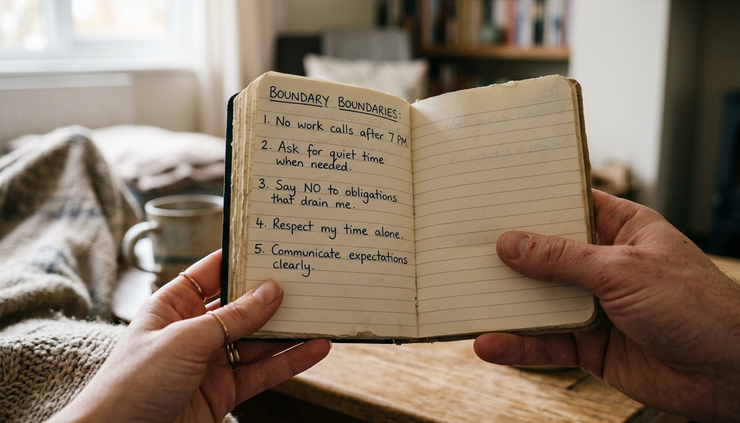
Can you recognise yourself in these patterns?
People pleasing does not always look dramatic. Often it appears as politeness, reliability, flexibility, or being “low maintenance”.
You may recognise yourself if you often:
say yes quickly, then feel trapped afterwards
feel responsible for other people’s moods
apologise when you have not done anything wrong
avoid sharing preferences because you do not want to be difficult
feel anxious when someone is disappointed
give long explanations for simple limits
feel resentful but keep smiling
feel proud of being needed, then exhausted by it
struggle to know what you want until someone else says what they want
worry that boundaries will make you less lovable
These patterns may be especially strong in close relationships. It can be easier to say no to a stranger than to a parent, partner, sibling, friend, or colleague whose approval matters.
That is because boundaries are not only practical. They are relational. They ask the question, “Can I still belong if I am honest?”
A psychodynamic view of the “good” self
Many people pleasers have built an identity around being good.
Good might mean helpful. Calm. Available. Understanding. Low need. Forgiving. Strong. The one who copes.
There may be real kindness in this identity. There may also be pressure. If being good means never disappointing anyone, then your humanity has nowhere to go.
No person can be endlessly generous without limits. No person can be emotionally available at all times. No person can protect others from every frustration.
When the “good self” becomes too rigid, ordinary boundaries can feel like moral failure. Saying no can feel as if you are becoming someone bad, even when you are simply being honest.
This is where deeper work begins. You start to separate kindness from compliance. You learn that care does not require self-erasure.
How to begin setting better boundaries
Boundary work does not usually start with a perfect speech. It starts with noticing.
Before changing what you say to others, you begin by listening to what happens inside you.
Notice your body’s first answer
The body often responds before the conscious mind catches up.
Pay attention to small signals:
tightness in your throat
heaviness in your chest
irritation
dread
sudden tiredness
a forced smile
a rushed urge to agree
These signals do not automatically mean you must say no. They mean you need a pause.
A useful first boundary is time.
Try saying:
“Let me think about that and come back to you.”
“I need to check what I can manage.”
“I can’t answer right now.”
“I’ll let you know tomorrow.”
This interrupts the automatic yes. It gives your adult self time to enter the conversation.
Expect guilt without obeying it
When you start setting boundaries, guilt may rise. This does not mean the boundary is wrong.
If guilt has been trained into you over many years, it may appear whenever you act differently. Treat it as emotional weather, not a command.
You might say to yourself:
“I feel guilty because this is unfamiliar. That does not mean I have done harm.”
This small distinction matters. Healthy guilt asks for repair. Old guilt often asks for surrender.
Use simple language
People pleasing often comes with over-explaining. The hope is that if the other person fully understands, they will not be upset.
Sometimes explanation helps. Often, too much explanation invites negotiation.
Simple boundaries can sound like:
“I can’t make it this time.”
“I’m not available for that.”
“I don’t have the capacity to help with this.”
“That doesn’t work for me.”
“I can do half an hour, but not the whole afternoon.”
You do not need to sound cold. Warmth and firmness can sit together.
For example:
“Thanks for asking me. I can’t help this weekend, but I hope it goes well.”
That is clear, kind, and complete.
Start with low-risk boundaries
If saying no feels frightening, begin where the emotional stakes are lower. Practise with small choices.
Choose the restaurant. Send a message later rather than instantly. Decline an invitation when you are tired. Say you would prefer a different time.
Small acts teach the psyche something new: connection can survive your separateness.
Over time, the inner world updates. Not all at once, but through repeated experience.
Watch how people respond
Boundaries reveal relationship dynamics.
Some people may respect your no easily. Some may feel surprised because the pattern is changing. Some may push back, guilt-trip, sulk, or act hurt.
Their response gives useful information.
If someone can only stay warm when you comply, the relationship may have depended on your lack of boundaries. That can be painful to see. It can also help you make more honest choices about how much access that person has to your time and energy.
Let yourself mourn the old role
Changing people pleasing can bring grief. Even when a pattern is painful, it may also feel familiar. It may have helped you feel valued. It may have protected you. It may have shaped your sense of identity.
You may miss being the one everyone relies on. You may fear becoming less special. You may feel unsure who you are if you are no longer always pleasing.
This is part of the work.
You are not just learning new phrases. You are building a new relationship with yourself.
A final thought on guilt, care, and self-respect
Saying no feels hard when no has been given a frightening meaning. It may feel like rejection, selfishness, danger, or loss of love. From a psychodynamic perspective, the task is not simply to become more assertive. It is to understand the emotional history that made self-protection feel unsafe.
A better boundary does not mean caring less. It means including yourself in the circle of care.
Start small. Pause before answering. Notice the guilt without letting it decide for you. Practise clear, kind sentences. Pay attention to who respects your limits.
Each honest no makes space for a more honest yes. And over time, that can change not only your relationships, but the way you live inside yourself.


Comments